Case studies · 01
Laser soldering equipment, from zero to one
Starting from a failed laptop repair, my team turned temperature-controlled laser soldering into equipment we could build and sell.
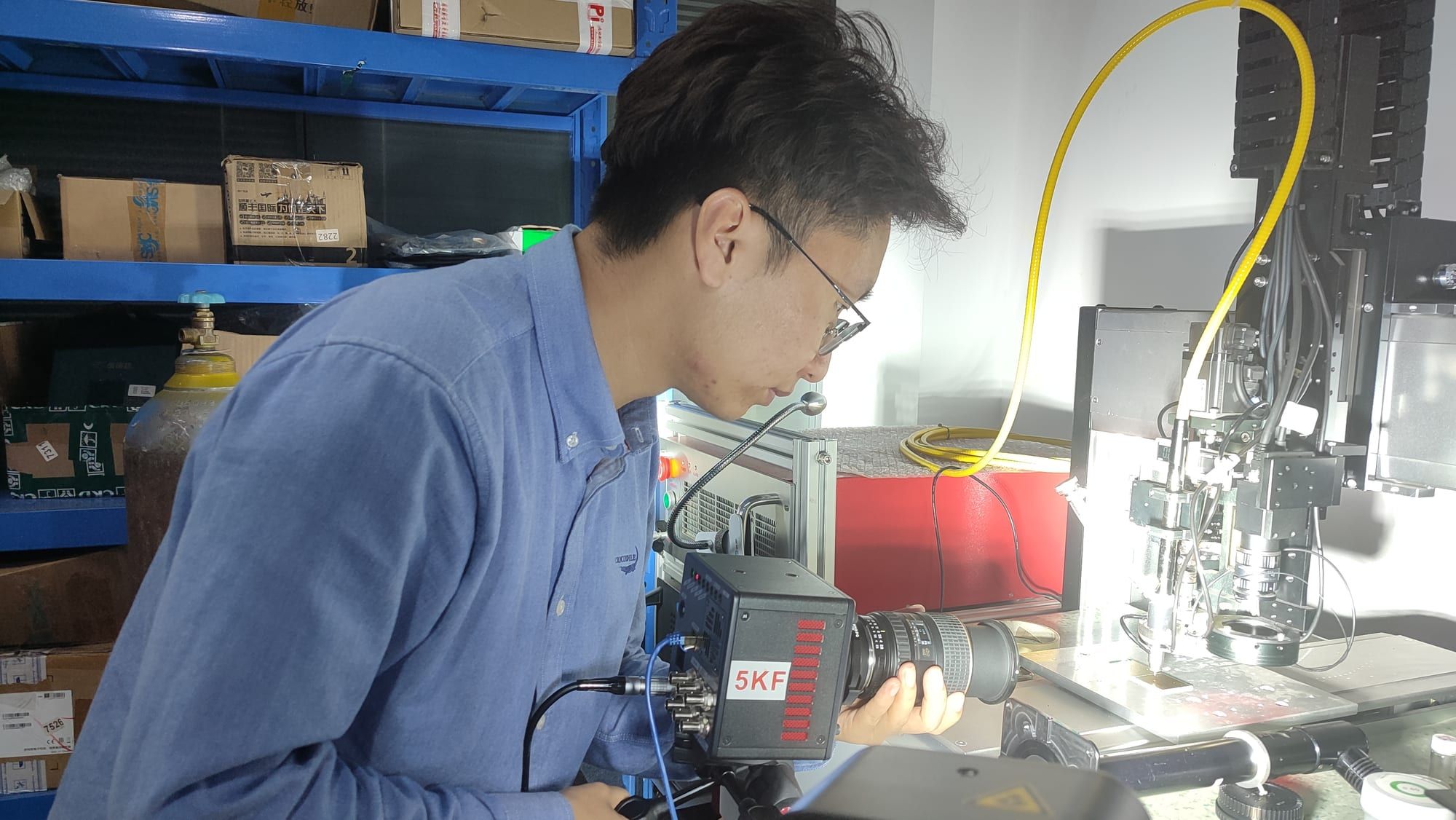
Context
Components such as phone camera modules, micro antennas and earphone coils have tiny solder joints and are sensitive to heat. At the time there were two ways to solder them precisely: buy imported laser soldering equipment, at more than a million RMB per unit and out of reach for small contract manufacturers, or solder by hand with an iron, which is slow and inconsistent.
A laser is an excellent heat source; the hard part is temperature control. Its energy density is so high that the board heats up almost instantly, and without control it burns the components. That is exactly how we “fixed” our first laptop into the grave.
My role
I was a partner on the startup team and its product manager. I was responsible for:
- Researching needs with electronics ODM and OEM customers, mapping use cases, technical routes and competitors;
- Product definition and development pace, and design work on the motion platform, wire feeder, clamping, enclosure and control software;
- Process tests with customers, business plans, competitions and pitches.
Approach
Define the problem first. Early on we spent a lot of time on algorithms, using fuzzy control and neural networks to correct the temperature. But we were measuring at a different spot from the joint, so every correction arrived too late.
Change the physical structure. We merged the infrared temperature path into the laser’s optics so the sensing beam and the laser were coaxial and met at the same focal point: wherever the laser hits, that is where the temperature is measured. In the end five light paths shared one axis (the laser, a pointer, illumination, CCD vision and infrared sensing), combined with variable-structure PID control.
Let the customer’s line decide. The equipment went into customer production lines for real processing tests, compared with conventional methods on yield and stability, at about half the price of comparable imported machines.
Turn disagreements into options. The mechanical, electrical and optics people each had their own “best” design. We wrote up a few options with their trade-offs from the product’s point of view and let the team choose. When we still could not agree, we built both and tested them.
Results
- Laser temperature held within ±2°C, with solder joints as small as 80 μm, roughly the width of a single human hair;
- A yield of 98.7% in a real processing test on a customer’s line;
- Used on light- and heat-sensitive parts such as phone camera modules, micro antennas, earphone coils and optical communication modules;
- About RMB 3 million in revenue in 2021, high-tech enterprise certification and Hubei startup funding for college students;
- Awards including first prize at the 2022 Challenge Cup national finals, a national gold award at the 2023 Internet+ competition, and first prize at the 2020 China-US Young Maker Competition finals.
After I was recommended for a master’s place at Huazhong University of Science and Technology in 2022, I began handing day-to-day work over to teammates.
Looking back, it taught me three things: find a real pain point before picking a technical route; when algorithms cannot get around a problem, try changing the structure; and settle team disagreements with options and experiments.